In the tropical climate of Thailand, maintaining a cool and productive environment in a factory or warehouse isn’t just about comfort; it’s about operational efficiency. High humidity and trapped heat can damage inventory and reduce worker productivity.
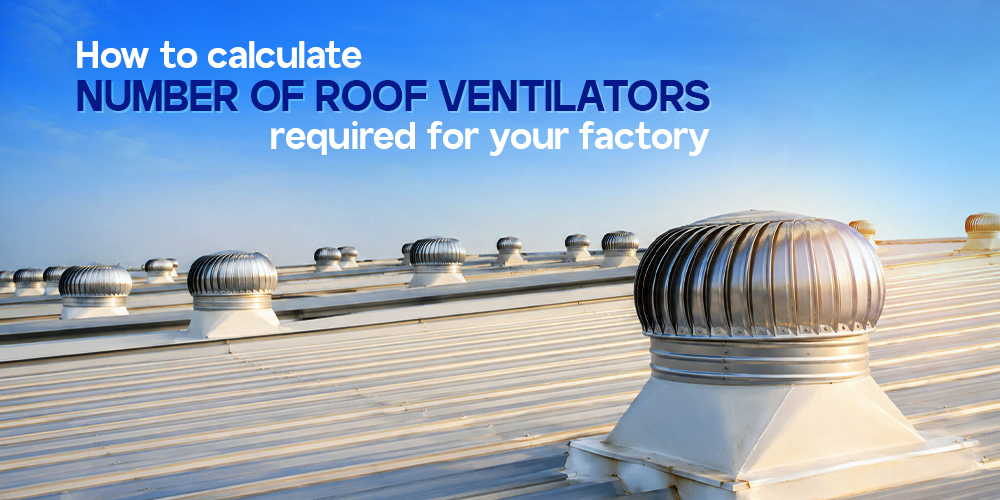
If you are looking to install industrial roof ventilators in Thailand, the most common question is: “How many roof ventilators do I need for my factory?”
At RISEECOVENT, we believe in precision. Installing too few units won’t solve your heat problem, and installing too many is an unnecessary expense. Here is our expert guide on how to calculate the number of roof ventilators required for your facility.
Understanding the Air Change Rate (ACH)
Before you dive into the math, you need to understand ACH (Air Changes per Hour). This is a measure of how many times the total volume of air within a space is replaced with fresh outdoor air in one hour.
For factory ventilation in Thailand, the recommended ACH typically ranges from 10 to 30, depending on the heat generated inside:
- Warehouses: 10–15 ACH
- General Manufacturing: 15–20 ACH
- High-Heat Factories (Foundries/Bakeries): 25–30+ ACH
The Industrial Ventilation Design Calculation Formula
To find the exact number of roof ventilators required, follow this three-step factory ventilation calculation:
1. Calculate the Volume of Your Building
First, determine the total space (in cubic meters) that needs ventilating.
$$V = Length \times Width \times Average Height$$
2. Determine the Total Exhaust Volume Needed
Multiply the building volume by your required ACH to find out how much air needs to be moved every hour.
$$Q = V \times ACH$$
(Where $Q$ is the Total Air Flow required in $m^3/hr$)
3. Calculate the Number of Units
Divide the total air flow ($Q$) by the exhaust capacity of a single roof ventilator. Note that capacity varies by model and wind speed.
$$Number\ of\ Units = \frac{Q}{Exhaust\ Capacity\ per\ Unit}$$
Example Calculation for a Warehouse in Thailand
Imagine a warehouse with the following dimensions:
- Length: 40 meters
- Width: 20 meters
- Height: 8 meters
- Building Volume ($V$): $6,400\ m^3$
If we choose an ACH of 15 for standard warehouse ventilation:
- Total Airflow Needed ($Q$): $6,400 \times 15 = 96,000\ m^3/hr$
If a single RISEECOVENT industrial ventilator exhausts $3,500\ m^3/hr$:
- Units Required: $96,000 / 3,500 \ approx 27\ units$
How to Improve Factory Ventilation in Thailand
Beyond just the number of units, the industrial ventilation design matters. To maximise airflow:
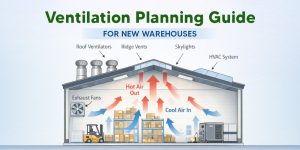
- Placement: Install ventilators along the ridgeline for maximum hot air extraction.
- Inlet Air: Ensure there are enough windows or louvres at the lower level. Ventilation is a "push-pull" system; you cannot exhaust air if new air cannot enter.
- Roof Ventilator Requirement per Square Meter: While a rough estimate is 1 unit per $50 \text {--}100\ m^2$, always use the volume-based formula above for accuracy.
Frequently Asked Questions (FAQ)
The calculation is based on building volume, the required Air Changes per Hour (ACH), and the exhaust capacity of the specific ventilator model.
The core formula is $Q = V \times ACH$, where $V$ is volume and $Q$ is the total air volume to be moved per hour.
On average, one industrial roof ventilator covers between $50$ to $100$ square meters, but this depends heavily on the ceiling height and the heat load of the building.
ACH stands for Air Changes per Hour. It signifies how many times the entire volume of air in a room is replaced by fresh air within 60 minutes.
To improve factory ventilation in Thailand, combine natural roof ventilators with properly positioned wall louvres to create a “stack effect,” allowing hot air to rise and exit while drawing cool air in from below.
Need a professional assessment?
At RISEECOVENT, we specialise in high-performance industrial roof ventilators in Thailand. Contact us today for a custom ventilation requirement for factory assessment and let our experts help you design a cooler, more efficient workspace.