Designing a new warehouse involves more than layout, storage systems, and logistics flow. One critical factor that directly affects worker safety, product quality, energy costs, and operational efficiency is ventilation.
Poor airflow can lead to excessive heat build up, humidity, condensation, dust accumulation, and hazardous working conditions. In rapidly growing logistics hubs like Vietnam, Dubai, and New Zealand, climate-appropriate ventilation planning is essential from the early design stage.
A well-designed warehouse ventilation system ensures comfortable working conditions, protects stored goods, and reduces long-term operational expenses.
Why Ventilation Is Critical for Modern Warehouses
Warehouses typically have large roof areas, high ceilings, and limited natural airflow. Without proper ventilation, heat generated by machinery, lighting, solar radiation, and stored materials accumulates quickly.
Effective ventilation helps to:
- Remove hot air trapped near the roof
- Control humidity and condensation
- Improve indoor air quality
- Reduce worker fatigue and heat stress
- Prevent mold and corrosion
- Protect temperature-sensitive goods
For large distribution centres, ventilation planning is not optional — it is a core infrastructure requirement.
Climate-Specific Challenges by Region
Hot & Humid Climate — Vietnam
In Vietnam, warehouses face:
- High temperatures year-round
- Heavy humidity
- Frequent rainfall
- Risk of condensation and mold
Ventilation systems must focus on moisture control and continuous air exchange to prevent product damage and structural deterioration.
Extreme Heat & Desert Conditions — Dubai
Warehouses in Dubai experience
- High temperatures year-round
- Heavy humidity
- Frequent rainfall
- Heavy reliance on cooling systems
Natural ventilation combined with heat extraction solutions can significantly reduce cooling loads and energy consumption.
Mild but Variable Climate — New Zealand
In New Zealand, conditions include:
- Moderate temperatures
- Seasonal humidity changes
- Rain and moisture exposure
- Need for condensation control
Ventilation planning must balance airflow with weather protection to maintain stable indoor conditions.
Key Factors in Warehouse Ventilation Planning
1. Building Size & Layout
The volume of air inside the warehouse determines ventilation capacity requirements.
Important considerations:
- Ceiling height
- Floor area
- Storage density
- Obstructions to airflow
- Mezzanine levels
- Racking systems
Large high-bay warehouses need powerful roof-level heat extraction.
2. Type of Stored Goods
Different products require different environmental conditions.
Examples:
- Electronics → Low humidity
- Food products → Controlled temperature & airflow
- Chemicals → Fume extraction
- Paper & textiles → Moisture control
- Machinery → Dust management
Ventilation design must align with storage requirements.
3. Heat Sources Inside the Warehouse
Heat is generated not only by weather but also by internal operations.
Common heat contributors:
- Forklifts and machinery
- Lighting systems
- Charging stations
- Production processes
- Human activity
- Roof heat gain
Identifying these sources helps determine airflow requirements.
4. Natural vs Mechanical Ventilation
Most modern warehouses use a combination of both.
🌬️ Natural Ventilation
Uses wind and thermal buoyancy to move air without electricity.
Benefits:
- Energy-efficient
- Low maintenance
- environmentally friendly
- Continuous operation
Identifying these sources helps determine airflow requirements.
⚡ Mechanical Ventilation
Uses powered fans and HVAC systems.
Benefits:
- Precise airflow control
- Suitable for enclosed environments
- Effective for hazardous areas
Hybrid systems often provide the best performance.
5. Roof Ventilation Systems
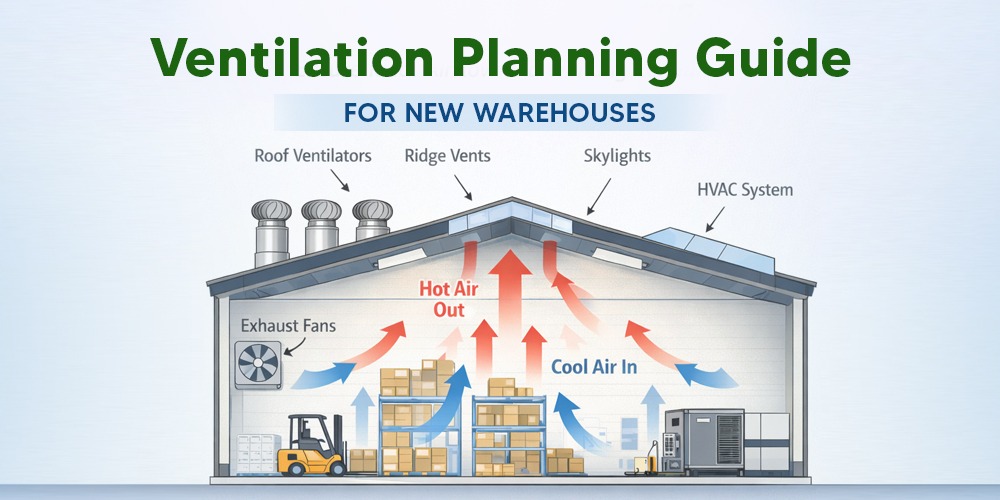
Since hot air rises, roof-mounted systems are the most effective way to remove accumulated heat.
Common solutions include:
- Wind-driven turbo ventilators
- Ridge ventilators
- Gravity vents
- Powered roof extractors
- Skylight ventilators
These systems continuously exhaust hot air without interfering with floor operations.
6. Air Changes Per Hour (ACH)
ACH indicates how many times the air inside a building is replaced per hour.
Higher ACH is required for:
- High heat loads
- Dust-producing operations
- Chemical storage
- Dense occupancy
Proper calculation ensures effective ventilation without over-engineering.
Energy Efficiency & Cost Savings
Cooling large warehouses using air conditioning alone is extremely expensive, especially in hot regions like Dubai and Vietnam.
Passive ventilation can:
- Reduce indoor temperature naturally
- Lower HVAC usage
- Cut electricity bills
- Support sustainability goals
- Improve carbon footprint
For new facilities, investing in proper ventilation design delivers long-term operational savings.
Safety & Regulatory Considerations
Proper ventilation supports workplace safety standards by:
- Preventing heat stress
- Removing fumes and pollutants
- Reducing fire risk
- Controlling dust accumulation
- Improving visibility and comfort
Many international safety guidelines require adequate airflow in industrial buildings.
Best Time to Plan Ventilation — During Design Stage
Retrofitting ventilation later is far more expensive and disruptive.
Early planning allows:
- Integration with building structure
- Optimal placement of roof openings
- Proper load calculations
- Coordination with insulation systems
- Better energy modelling
Architects, engineers, and ventilation specialists should collaborate from the start.
Why Choose Professional Ventilation Solutions
Each warehouse has unique requirements based on location, operations, and building design.
A specialized ventilation provider can deliver:
- Site-specific airflow analysis
- Climate-appropriate solutions
- Custom system design
- Installation expertise
- Long-term performance reliability
Final Thoughts
Warehouse ventilation is not just about comfort — it directly impacts productivity, safety, product integrity, and operating costs.
For rapidly expanding logistics markets like Vietnam, Dubai, and New Zealand, climate-responsive ventilation planning is essential for future-ready facilities.
By integrating efficient natural and mechanical ventilation systems at the design stage, businesses can create warehouses that are safer, more energy-efficient, and better suited for long-term growth.
Need Ventilation Solutions for Your New Warehouse?
Riseecovent provides advanced industrial ventilation systems tailored for diverse climates and large-scale facilities.
Contact the team to discuss solutions for your project in Vietnam, Dubai, or New Zealand.